the real mbti: jungian cognitive functions
- Aug 21, 2022
- 1 min read
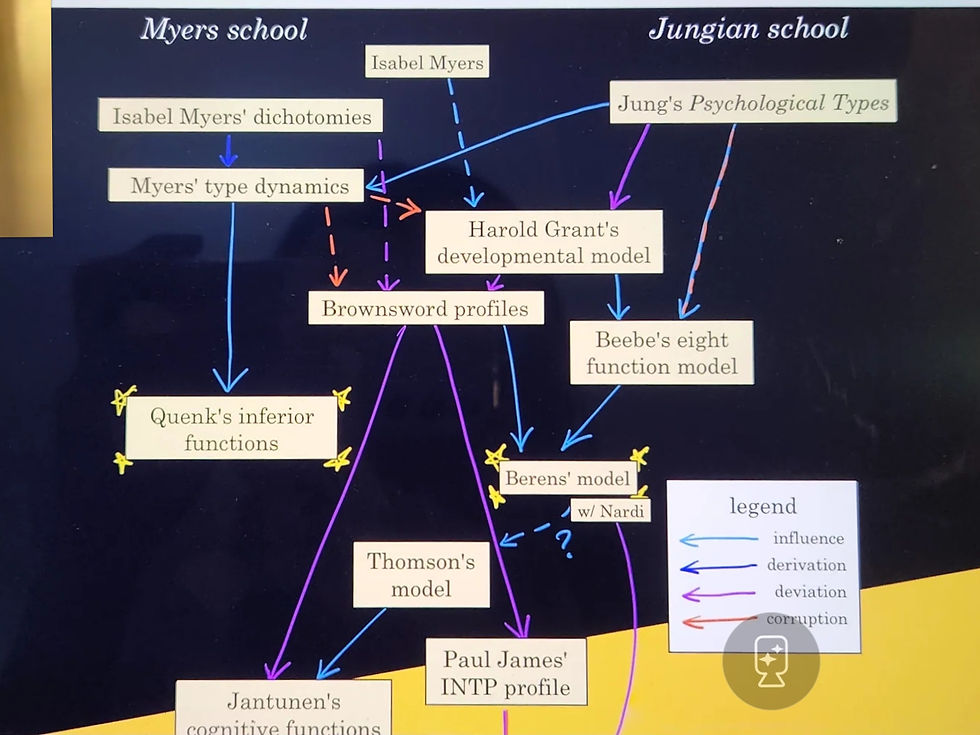
Over the summer, I became intrigued by the Meyers-Briggs Type Indicator (MBTI) test and its origins. I knew the "16Personalities" website was the one that had popularized MBTI to the general public, but I had also heard that there was a different, "real" MBTI that was based on actual psychology. I ended up becoming extremely invested in this topic and did hours and hours of research into it.
I found that the MBTI test had many influences, as shown in the picture above, but it was primarily inspired by Carl Jung's Psychological Types, where he describes four main psychological functions: thinking, feeling, sensation, and intuition. He states that there is one dominant function, two auxiliary functions, and one inferior function. This differs significantly from the more simplistic dichotomies of the Meyers-Briggs model. Additionally, the Meyers-Briggs model is meant to be an assessment of overall personality traits, which can fluctuate depending on the situation. Jung's model refers specifically to the cognitive processes within a person's psyche, which stay the same throughout a person's life.
Doing deep dives into random topics like this is practically my hobby. I love research, I love learning new things, and I love being able to apply them to my life. I made pretty much all of my friends take a really long, detailed cognitive functions test so that I could compare their Meyers-Briggs result to their Jungian result. Making connections, doing analysis, and finding patterns are what I live for.